Schotel (Q4819)
Naar navigatie springen
Naar zoeken springen
Zhangzhou schotel op voetring, smalle platte rand. Versierd in bovenglazuur ijzerrood en twee kleuren groen email. In he... met elkaar verbonden en vormen zo het symbool van het Absolute (taiji). Ee...||JMD-P-1993||Zhangzhou||Onbekend||JMD-P-1993
| Taal | Label | Beschrijving | Ook bekend als |
|---|---|---|---|
| Nederlands | Schotel |
Zhangzhou schotel op voetring, smalle platte rand. Versierd in bovenglazuur ijzerrood en twee kleuren groen email. In he... met elkaar verbonden en vormen zo het symbool van het Absolute (taiji). Ee...||JMD-P-1993||Zhangzhou||Onbekend||JMD-P-1993 |
Verklaringen
Swatow schotel op voetring, smalle platte rand. Versierd in bovenglazuur ijzerrood en twee kleuren groen email. In het midden een variant op het Yin-Yang symbool omgeven door een rode band. Daar rondom twee draken die elk een vlammende parel najagen temidden van wolkmotieven. Op de wand vier bloemtakken (pioen, chrysant, lotus en andere bloemen) gescheiden door vier vakken waarin de karakters zhong, xin, xiao en di (de jongere broer die zijn ouders eert, trouw is en vertrouwen geniet). De rand met ranken en halve rode cirkels. Op de buitenkant drie groepen ranken in rood. Op de onderkant aangebakken ovenzand. (Nederlands)
0 bronnen
Swatow dish on footring, narrow flat rim. Decorated in overglaze iron-red and two shades of green enamel. In the centre a variation on the Yin-Yang symbol surrounded by a red band. Around this two dragons chasing a flaming pearl between cloud motifs. On the sides four flower sprays (peony, chrysanthemum, lotus and another flower) separated by four panels containing the characters zhong, xin, xiao and di (the younger brother who honours his parents, is loyal and trusted). The rim with scrolls and red semicircles. On the outside three groups of red scrolls. Kiln-sand adhering to base. (Engels)
0 bronnen
JMD-P-1993
0 bronnen
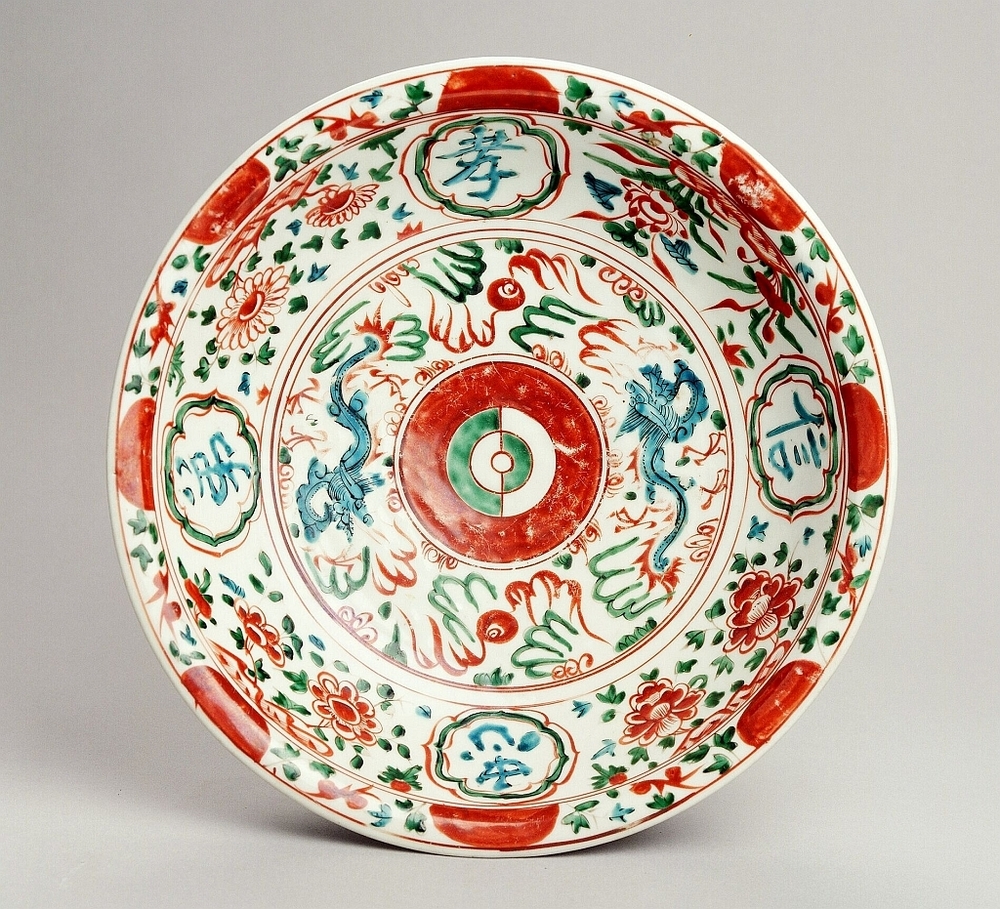
Zhangzhou schotel op voetring, smalle platte rand. Versierd in bovenglazuur ijzerrood en twee kleuren groen email. In het midden een variant op het Yin-Yang symbool omgeven door een rode band. Daar rondom twee draken die elk een vlammende parel najagen temidden van wolkmotieven. Op de wand vier bloemtakken (pioen, chrysant, lotus en andere bloemen) gescheiden door vier vakken waarin de karakters zhong, xin, xiao en di (de jongere broer die zijn ouders eert, trouw is en vertrouwen geniet). De rand met ranken en halve rode cirkels. Op de buitenkant drie groepen ranken in rood. Op de onderkant aangebakken ovenzand. De halve rode cirkels zijn verwant aan de rode medaillons zoals die op Wanli export porselein voor de zuid-oost Aziatische markt en Japan wordt aangetroffen (zie cat. 11{}) en mede op grond daarvan is dit stuk gedateerd. De Yin-Yang symboliek is oeroud en speelt een belangrijke rol in het Daoisme. Yin (hier groen) staat voor het vrouwelijke principe, het mysterieuze, de aarde, de maan, terwijl Yang (wit) het mannelijke principe is, de hemel, de zon, het licht. In dit symbool zijn ze onlosmakelijk met elkaar verbonden en vormen zo het symbool van het Absolute (taiji). Ee... (Nederlands)
Zhangzhou dish on footring, narrow flat rim. Decorated in overglaze iron-red and two shades of green enamel. In the centre a variation on the Yin-Yang symbol surrounded by a red band. Around this two dragons chasing a flaming pearl between cloud motifs. On the sides four flower sprays (peony, chrysanthemum, lotus and another flower) separated by four panels containing the characters zhong, xin, xiao and di (the younger brother who honours his parents, is loyal and trusted). The rim with scrolls and red semicircles. On the outside three groups of red scrolls. Kiln-sand adhering to base. The semicircles are related to the red medallions on Wanli export porcelain for the south-east Asian market and Japan (see cat. 11{}), and this piece has been dated on that basis. The Yin-Yang symbol is extremely old and has an important function in Daoism. Yin (green) represents the feminine aspects–the mysterious, the earth and the moon, while Yang (white) represents the masculine aspects–heaven, the sun and light. Here they are inextricably entwined, thus forming the symbol of the Absolute (taiji). Another shape better known in the West is a circle divided into a darker and a lighter half by a... (Engels)
Swatow dish on footring, narrow flat rim. Decorated in overglaze iron-red and two shades of green enamel. In the centre a variation on the Yin-Yang symbol surrounded by a red band. Around this two dragons chasing a flaming pearl between cloud motifs. On the sides four flower sprays (peony, chrysanthemum, lotus and another flower) separated by four panels containing the characters zhong, xin, xiao and di (the younger brother who honours his parents, is loyal and trusted). The rim with scrolls and red semicircles. On the outside three groups of red scrolls. Kiln-sand adhering to base. The semicircles are related to the red medallions on Wanli export porcelain for the south-east Asian market and Japan (see cat. 11{}), and this piece has been dated on that basis. The Yin-Yang symbol is extremely old and has an important function in Daoism. Yin (green) represents the feminine aspects–the mysterious, the earth and the moon, while Yang (white) represents the masculine aspects–heaven, the sun and light. Here they are inextricably entwined, thus forming the symbol of the Absolute (taiji). Another shape better known in the West is a circle divided into a darker and a lighter half by an S... (Engels)
20098691-7ad9-4589-b2cf-c04a745a2a55
onbekende waarde
Onbekend (Nederlands)
onbekende waarde
gebakken (Nederlands)
onbekende waarde
keramiek (Nederlands)
1575Gregoriaans
1575Gregoriaans
16e eeuw (Nederlands)