Kendi (Q4037)
Zhangzhou kendi op voetring, het brede, gedrukt-bolvormige lichaam uitlopend in een lange cylindrische nek met een wijd-...tails ongewoon zorgvuldig geschilderd is, zie bijvoorbeeld de vogel op de tak.||JMD-P-1186||Zhangzhou||Onbekend||JMD-P-1186
| Taal | Label | Beschrijving | Ook bekend als |
|---|---|---|---|
| Nederlands | Kendi |
Zhangzhou kendi op voetring, het brede, gedrukt-bolvormige lichaam uitlopend in een lange cylindrische nek met een wijd-...tails ongewoon zorgvuldig geschilderd is, zie bijvoorbeeld de vogel op de tak.||JMD-P-1186||Zhangzhou||Onbekend||JMD-P-1186 |
Verklaringen
Swatow kendi op voetring, het brede, gedrukt-bolvormige lichaam uitlopend in een lange cylindrische nek met een wijd-spreidende platte mondrand. Op de schouder een grote, borstvormige tuit. Versierd in bovenglazuur ijzerrood en groene emails met vier grote vakken gevuld met bloeiende planten en vogels, gescheiden door ruitwerk en halfronde rode medaillons. Op de tuit een draak, op de hals bloemtakken en vogels. (Nederlands)
0 bronnen
Swatow kendi on footring. The wide, flattened globular body tapers into a long cylindrical neck with a wide-spreading flat mouthrim. On the shoulder a large, mammiform spout. Decorated in overglaze iron-red and green enamels with four large panels filled with blooming plants and birds, separated by a diaper pattern and semicircular red medallions. On the spout a dragon, on the neck flower sprays and birds. (Engels)
0 bronnen
JMD-P-1186
0 bronnen
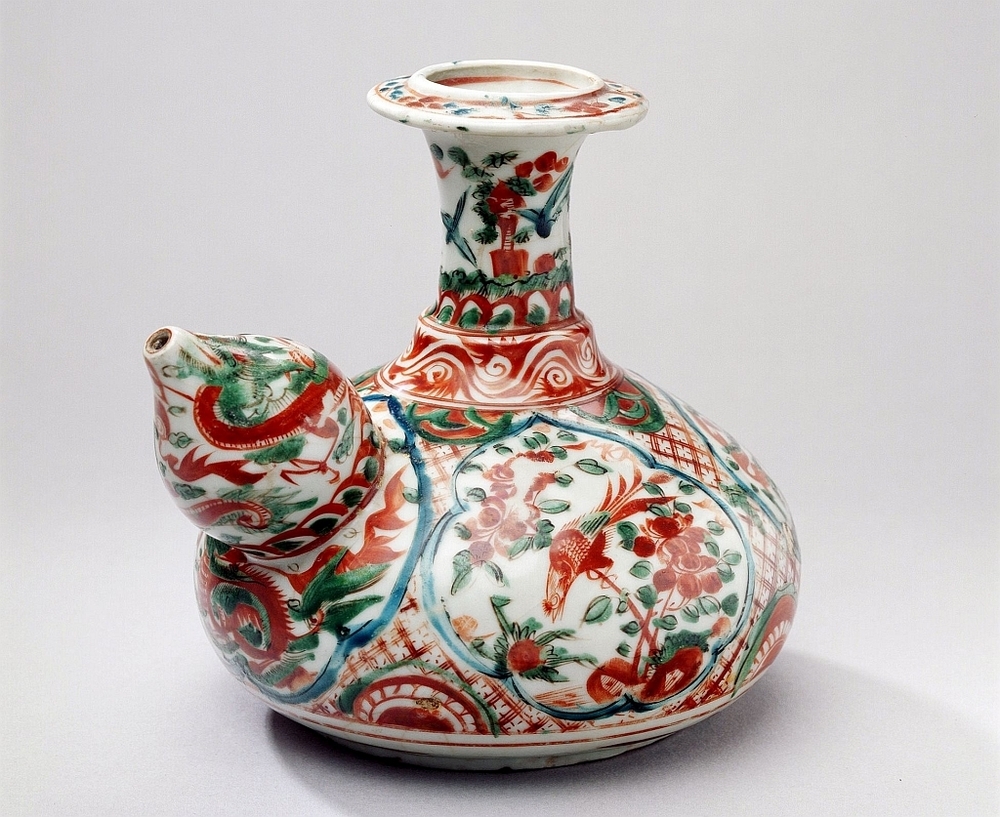
Zhangzhou kendi op voetring, het brede, gedrukt-bolvormige lichaam uitlopend in een lange cylindrische nek met een wijd-spreidende platte mondrand. Op de schouder een grote, borstvormige tuit. Versierd in bovenglazuur ijzerrood en groene emails met vier grote vakken gevuld met bloeiende planten en vogels, gescheiden door ruitwerk en halfronde rode medaillons. Op de tuit een draak, op de hals bloemtakken en vogels. De kendi was een export artikel voor de zuid-oost Aziatische markten zoals Maleisië, Indonesië en de Philipijnen, bestemd om er water of een andere drank in te bewaren, zonder dat er stof of vuil in kon komen. Men kon drinken van de straal uit de tuit, zonder met de mond aan de kendi te raken, een vorm van hygiene. In China (en Japan) werd de kendi niet gebruikt. Binnen Zhangzhou porselein zijn ze zeldzaam. Dit is een fraai exemplaar, dat in details ongewoon zorgvuldig geschilderd is, zie bijvoorbeeld de vogel op de tak. (Nederlands)
Zhangzhou kendi on footring. The wide, flattened globular body tapers into a long cylindrical neck with a wide-spreading flat mouthrim. On the shoulder a large, mammiform spout. Decorated in overglaze iron-red and green enamels with four large panels filled with blooming plants and birds, separated by a diaper pattern and semicircular red medallions. On the spout a dragon, on the neck flower sprays and birds. Kendi’s were made for export to south-east Asian markets such as Malaysia, Indonesia and The Phillippines, and were used to store water or other liquids and protect them from dust and other contaminants. Kendi’s were considered more hygenic as users could pour water directly into their mouths without having to touch the spout. They were not used in China (or Japan), and are rare in the Zhangzhou assortment. This is a splendid example, painted with much attention to detail; see, for example, the bird on the branch. (Engels)
Swatow kendi on footring. The wide, flattened globular body tapers into a long cylindrical neck with a wide-spreading flat mouthrim. On the shoulder a large, mammiform spout. Decorated in overglaze iron-red and green enamels with four large panels filled with blooming plants and birds, separated by a diaper pattern and semicircular red medallions. On the spout a dragon, on the neck flower sprays and birds. Kendi’s were made for export to south-east Asian markets such as Malaysia, Indonesia and The Phillippines, and were used to store water or other liquids and protect them from dust and other contaminants. Kendi’s were considered more hygenic as users could pour water directly into their mouths without having to touch the spout. They were not used in China (or Japan), and are rare in the Swatow assortment. This is a splendid example, painted with much attention to detail; see, for example, the bird on the branch. (Engels)
fd90eb0a-9cdf-480b-9cbf-0f39be995626
onbekende waarde
Onbekend (Nederlands)
onbekende waarde
gebakken (Nederlands)
onbekende waarde
keramiek (Nederlands)
1580Gregoriaans
1580Gregoriaans
16e eeuw (Nederlands)