(Q29598)
Verklaringen
1 bron
onbekende waarde
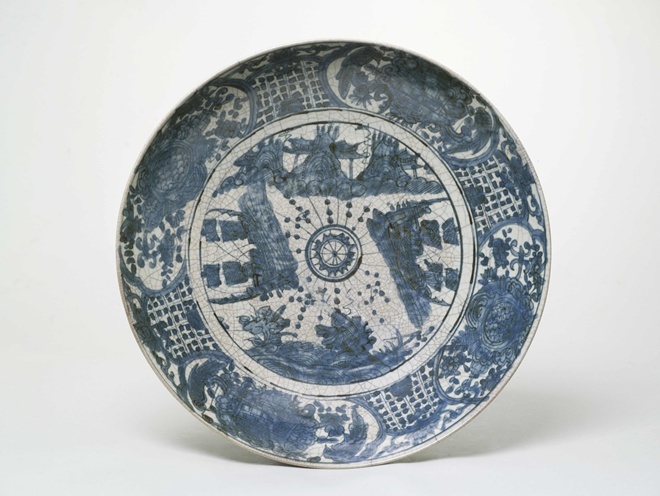
Schotel met decor van schepen, eiland en vissen die uit golven springen, Swatow (Nederlands)
1 bron
Navigation is represented on a distinct group of Zhangzhou dishes, decorated in cobalt blue and of rather big size of more than 40 cm. They have curving sides and straight edges. The centre of the design is formed by a marine rose with radiating lines. Around the marine rose are sailing ships with two masts and two tiers of sails, large fish and the elements of the Penglai islands, the islands of the immortals, represented by three mountains. A gigantic fish is leaping from the waters. The border has four oval medallions, filled with emblematic patterns. Marine roses were not part of Chinese cartography until the 20th century; they were part of a specific Western tradition of mapping known as portulan charts. The name portulan charts comes from the Italian portolano , meaning “port” or “harbor”. They are simple maps of navigational routes across water, using compass directions Portulan charts were mapping sea routes, but did not focus on the routes on water, rather mapping the coastlines along these sea routes, going back to the documentation of places in old rutters, tracks. The earliest surviving examples of this type can be dated into the 13th century, but they were still u... (Nederlands)
1 bron
GRV 1929-016
1 bron
Princessehof GRV 1929016
1 bron
Keramiekmuseum Princessehof, Leeuwarden; Bruikleen Gemeente Leeuwarden (Nederlands)
1 bron