(Q25111)
Verklaringen
onbekende waarde
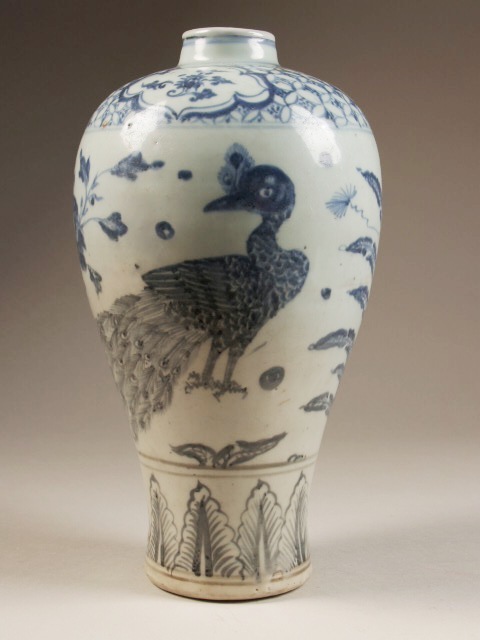
Vaas, meiping, met decor van 2 pauwen in een landschap met rotswerk en bloemranken (Nederlands)
1 bron
Meiping with an inward tapering neck and a thickened rim, the narrowing sides barely spreading out above the foot, the unglazed cracked base recessed within a broad footring. On the body, in a landscape, a peacock and a peahen among tree peonies, garden rocks and a banana plant. On the shoulder a petal diaper pattern reserved with three eight-lobed medallions with sprays. Above the foot a border of pointed leaves. The elongated form of this meiping is typical of the later Interregnum period. The peacock male is a symbol of beauty and dignity and from the Ming dynasty until the Republic tail feathers of the bird were used to indicate official rank. The charming but less refined design and the disproportionate rendering of the birds in the landscape point to a production in a min yao kiln. A meiping of sturdier form, a characteristic of the early Interregnum period, decorated with a peacock couple among tree peonies in the Palace Museum, Beijing, is attributed to the Zhengtong era (1436-1449). (Nederlands)
1 bron
GMP 1967-158
1 bron
Princessehof GMP 1967158
1 bron
Keramiekmuseum Princessehof, Leeuwarden; Bruikleen Gemeente Leeuwarden (Nederlands)
1 bron
onbekende waarde
China (Nederlands)
1 bron
onbekende waarde
1436Gregoriaans
1449Gregoriaans
Zhengtong (1436-1449) (Nederlands)
1 bron