Pair of blue and white aviary water dispensers (Q34007): verschil tussen versies
Naar navigatie springen
Naar zoeken springen
Verklaring aangemaakt: beschrijving (P113): They fly out at night to collect food and return the next morning to the pond bringing along the wild ducks. In order to actually attract the wild ducks into the trap pipes, a ‘lokstal’ (‘luring stable’) of tame ducks (the so-called ‘decoy ducks’) is used. These ducks live more or less permanently near the pond and are fed daily. The decoyman also uses a dog (‘kooikerhondje’ or ‘piper’) to attract the ducks into the pipes. From behind the reed s... |
Verklaring aangemaakt: beschrijving (P113): Although information on duck decoys is scarce, in the seventeenth and eighteenth centuries many of the Dutch country estates would have had a duck decoy on their land, a pursuit as common as finch lanes (vinkenbanen) and falconry. For instance, near Delft the owner of the now-lost Pasgeld residence, Pieter Teding van Berkhout (1643-1713), who indulged in hunting and catching finches and thrushes on his estate grounds, mentions in his diary in 16... |
||
| eigenschap / beschrijving | |||
Although information on duck decoys is scarce, in the seventeenth and eighteenth centuries many of the Dutch country estates would have had a duck decoy on their land, a pursuit as common as finch lanes (vinkenbanen) and falconry. For instance, near Delft the owner of the now-lost Pasgeld residence, Pieter Teding van Berkhout (1643-1713), who indulged in hunting and catching finches and thrushes on his estate grounds, mentions in his diary in 1686 the first ducks to reside in his duck (decoy) pond. The number of decoys declined during the eighteenth and nineteenth century due to intensified agriculture, changing water levels, and urbanization. From the 1,000 to 1,500 decoys that once existed, in 2008 only 113 remained. (Engels) | |||
| eigenschap / beschrijving: Although information on duck decoys is scarce, in the seventeenth and eighteenth centuries many of the Dutch country estates would have had a duck decoy on their land, a pursuit as common as finch lanes (vinkenbanen) and falconry. For instance, near Delft the owner of the now-lost Pasgeld residence, Pieter Teding van Berkhout (1643-1713), who indulged in hunting and catching finches and thrushes on his estate grounds, mentions in his diary in 1686 the first ducks to reside in his duck (decoy) pond. The number of decoys declined during the eighteenth and nineteenth century due to intensified agriculture, changing water levels, and urbanization. From the 1,000 to 1,500 decoys that once existed, in 2008 only 113 remained. (Engels) / rang | |||
Normale rang | |||
Versie van 24 jan 2024 13:42
geen beschrijving ingesteld
| Taal | Label | Beschrijving | Ook bekend als |
|---|---|---|---|
| Nederlands | Pair of blue and white aviary water dispensers |
geen beschrijving ingesteld |
Verklaringen
Delft (Nederlands)
Delft (Engels)
1 bron
28 sep 2023
onbekende waarde
circa 1710 (Engels)
circa 1710 (Nederlands)
1 bron
28 sep 2023
tin-glazed earthenware (Engels)
tingeglazuurd aardewerk (Nederlands)
1 bron
28 sep 2023
Aronson Delftware D1050
0 bronnen
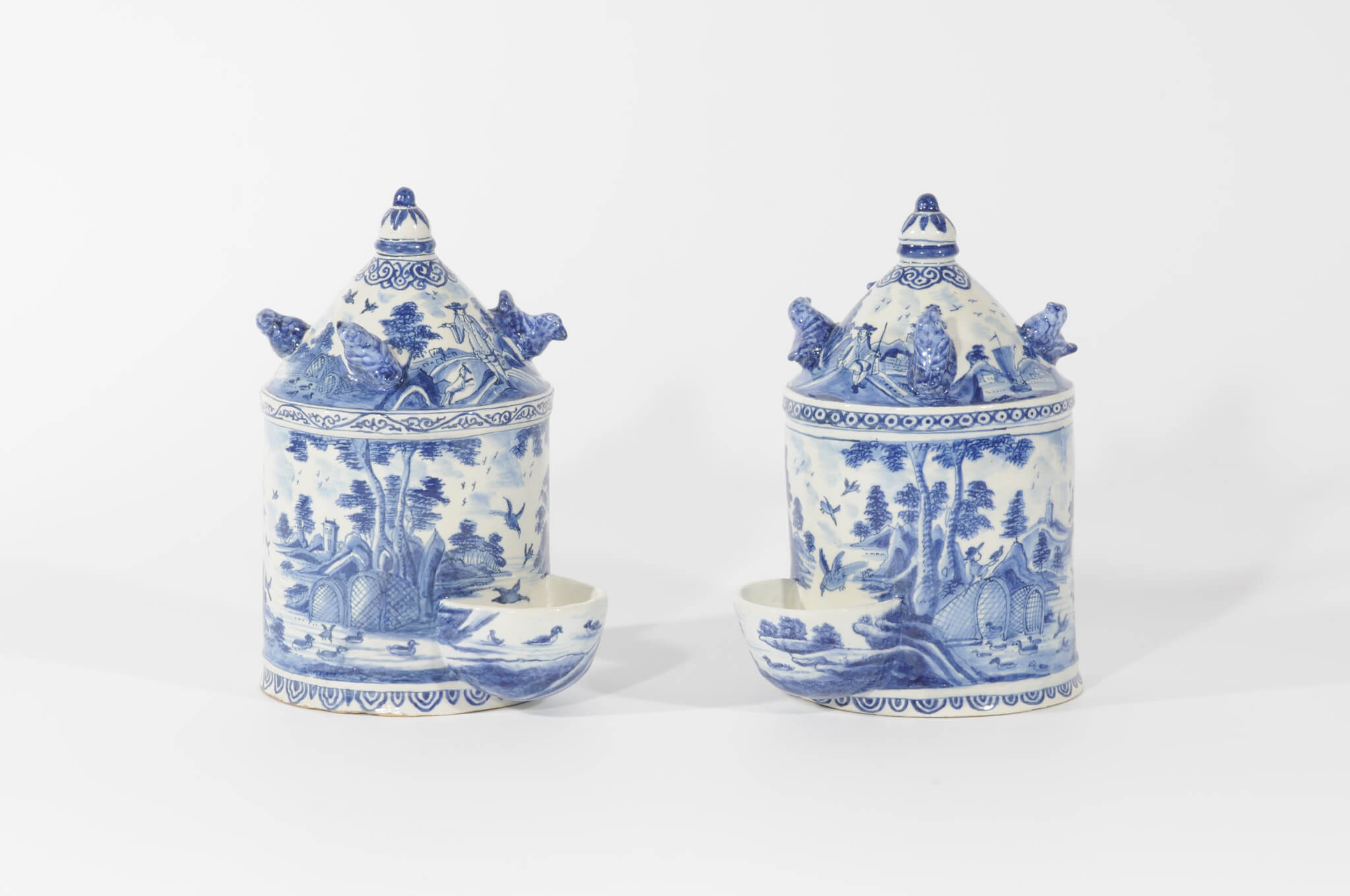
Heights: 22.9 and 22.6 cm. (9 and 8.9 in.) (Nederlands)
Heights: 22.9 and 22.6 cm. (9 and 8.9 in.) (Engels)
1 bron
28 sep 2023
Each painted around the cylindrical body with a different scene of sportsmen on the banks of a stream in a hilly landscape, one depicting a huntsman blowing a horn behind another mounted on his steed and shooting at a stag being pursued by two hounds, the reverse with ducks flying and swimming toward netted catching pipes of a duck decoy; the other with a man holding a bird near similar catching pipes before a distant horseman galloping across a bridge and being observed by a sportsman seated with his shotgun beside another standing and holding a felled duck and waiting for his retriever to deliver another; (Engels)
0 bronnen
each scene with its stream continuing onto the hemispherical trough at the front painted with swimming ducks beneath birds in flight on the reservoir above; the integral cylindrical covers painted with similar continuous scenes, the first with a dog bringing a bird to a man standing and holding a cage, the reverse with a lady seated and conversing with a standing man, the sides with birds flying and swimming; and the second with a seated sportsman on the front, a hound running toward a leaping stag on the reverse, a poodle running with a small creature in his mouth on one side, and a sailboat on the other; the cover vignettes interrupted by four applied blue birds below a ruyi-head border encircling the acorn- shaped knop; the lower edge of the cover with a slightly outset border of scrolls or dotted circlets, and the lightly flaring footrim with a border of petal devices. (Engels)
0 bronnen
These special containers are water dispensers for birds. When filled with water through the opening at the lower front and turned upright, the air pressure keeps the water leveled for a constant supply. Single bird feeders are seldom found in Dutch Delftware, but a pair such as this is possibly unique. The reservoirs are painted with continuous hunting scenes including a deer chase, duck-shooting and trapping by luring the birds into netted catching pipes (duck decoys, eendenkooi). This latter activity is rarely illustrated in the arts, and the decoration on these dispensers is currently its only known depiction on Dutch Delftware. (Engels)
0 bronnen
Duck decoys, generally set in wooded surroundings, consist of a quiet pond connected to ditches spanned with large hooped nets. The most common decoy pond is rectangular with curving ditches (catching pipes) at each corner, a shape referred to as ‘rogge-ei’ (‘ray-‘ or ‘skate’s egg’). Since ducks tend to take flight into the wind, the variously-aimed pipes ensure that a bird can be caught in any wind direction. The pond and pipes are enclosed by reed screens, enabling the ‘kooiker’ (‘decoyman’) to lure the ducks into a trap pipe without being noticed by the birds. Wild ducks are attracted to the decoy pond by the so-called ‘vliegstal’ (‘flying stable’ or ‘flock’) of a hundred to a thousand ducks that have flown into the trap pipes earlier, but have escaped, and therefore, will not swim into the ditches again.1 (Engels)
0 bronnen
They fly out at night to collect food and return the next morning to the pond bringing along the wild ducks. In order to actually attract the wild ducks into the trap pipes, a ‘lokstal’ (‘luring stable’) of tame ducks (the so-called ‘decoy ducks’) is used. These ducks live more or less permanently near the pond and are fed daily. The decoyman also uses a dog (‘kooikerhondje’ or ‘piper’) to attract the ducks into the pipes. From behind the reed screens, the decoyman throws grain over the screens and whistles to attract the tame ducks to the entrance of the pipe. The dog circles the screens, appearing in the ducks’ sight and then disappearing again behind the screens to pique the ducks’ curiosity. The wild ducks swim along with the tame ducks while the dog lures them further down the pipe. When passing the curve of the ditch, the wild ducks can no longer see the pond. Then the decoyman appears, frightening the ducks, who take off and fly towards the dead end of the pipe, and end up in the vanghokje (‘catching box’), trapped. (Engels)
0 bronnen
Although information on duck decoys is scarce, in the seventeenth and eighteenth centuries many of the Dutch country estates would have had a duck decoy on their land, a pursuit as common as finch lanes (vinkenbanen) and falconry. For instance, near Delft the owner of the now-lost Pasgeld residence, Pieter Teding van Berkhout (1643-1713), who indulged in hunting and catching finches and thrushes on his estate grounds, mentions in his diary in 1686 the first ducks to reside in his duck (decoy) pond. The number of decoys declined during the eighteenth and nineteenth century due to intensified agriculture, changing water levels, and urbanization. From the 1,000 to 1,500 decoys that once existed, in 2008 only 113 remained. (Engels)
0 bronnen