‘Black Delftware’ fluted rectangular tea canister and cover (Q34056): verschil tussen versies
Naar navigatie springen
Naar zoeken springen
Verklaring gewijzigd: beschrijving (P113): The body lightly molded on the front and reverse with an oval panel edged in yellow dots and a green band andpainted on the front with a bird in flight above the pavilion in a Chinese landscape, and on the reverse with flowering plants, each surrounded by four clusters of iron-red and white flowers and green and yellow foliage; the sides with an insect flitting above further flowering plants and a blue stylized rock, the shoulder with a red scro... |
Verklaring aangemaakt: beschrijving (P113): Note: ‘Black Delft’ was the rarest production of a very few Dutch Delft factories during the late seventeenth and early eighteenth century when the taste for the exotic thrived. These black-glazed Delftwares were inspired by Oriental and subsequent European lacquer wares as well as by Chinese ‘famille noire’ porcelain of the Kangxi period (1662-1722), both the so-called ‘mirror black’ type with its lustrous monochromatic ground, often left undec... |
||
| eigenschap / beschrijving | |||
Note: ‘Black Delft’ was the rarest production of a very few Dutch Delft factories during the late seventeenth and early eighteenth century when the taste for the exotic thrived. These black-glazed Delftwares were inspired by Oriental and subsequent European lacquer wares as well as by Chinese ‘famille noire’ porcelain of the Kangxi period (1662-1722), both the so-called ‘mirror black’ type with its lustrous monochromatic ground, often left undecorated or ornamented only in gilding, and the type decorated in a ‘famille verte’ palette of predominantly green enamel. On Chinese porcelain pieces without a black ground, the ‘famille verte’ palette also included iron red, yellow, aubergine, black and overglaze and underglaze blue – and it was with this full palette of colors that the Delft potters sought to enliven the gleaming dark glaze of their ‘Black Delft’. (Engels) | |||
| eigenschap / beschrijving: Note: ‘Black Delft’ was the rarest production of a very few Dutch Delft factories during the late seventeenth and early eighteenth century when the taste for the exotic thrived. These black-glazed Delftwares were inspired by Oriental and subsequent European lacquer wares as well as by Chinese ‘famille noire’ porcelain of the Kangxi period (1662-1722), both the so-called ‘mirror black’ type with its lustrous monochromatic ground, often left undecorated or ornamented only in gilding, and the type decorated in a ‘famille verte’ palette of predominantly green enamel. On Chinese porcelain pieces without a black ground, the ‘famille verte’ palette also included iron red, yellow, aubergine, black and overglaze and underglaze blue – and it was with this full palette of colors that the Delft potters sought to enliven the gleaming dark glaze of their ‘Black Delft’. (Engels) / rang | |||
Normale rang | |||
Versie van 12 jan 2024 13:25
geen beschrijving ingesteld
| Taal | Label | Beschrijving | Ook bekend als |
|---|---|---|---|
| Nederlands | ‘Black Delftware’ fluted rectangular tea canister and cover |
geen beschrijving ingesteld |
Verklaringen
onbekende waarde
Probably De Metaale Pot (The Metal Pot) factory (Engels)
Probably De Metaale Pot (The Metal Pot) factory (Nederlands)
1 bron
28 sep 2023
Delft (Nederlands)
Delft (Engels)
1 bron
28 sep 2023
onbekende waarde
circa 1720 (Engels)
circa 1720 (Nederlands)
1 bron
28 sep 2023
Aronson Delftware D1436
0 bronnen
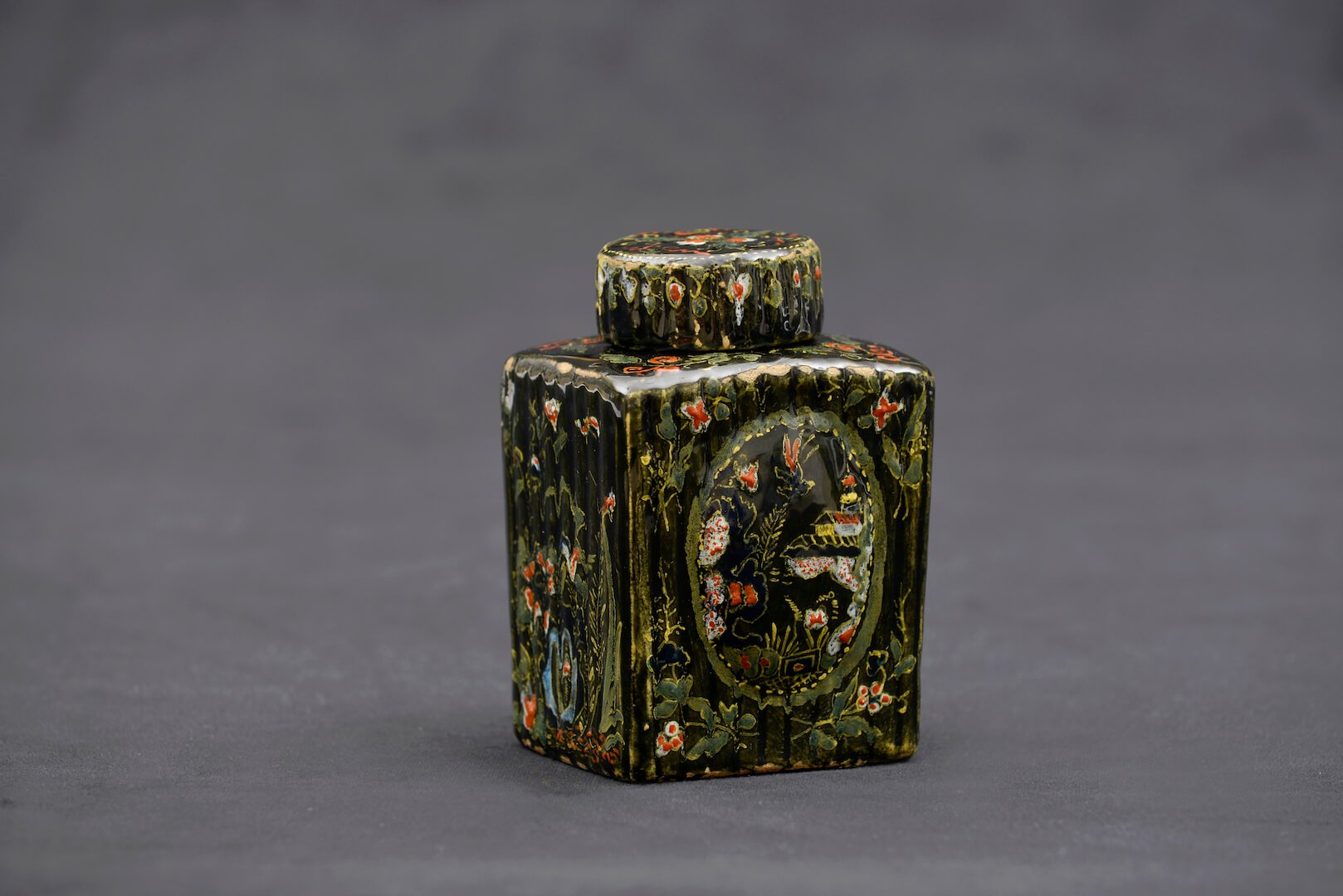
Height: 10.5 cm. (4 1/8 in.) (Nederlands)
Height: 10.5 cm. (4 1/8 in.) (Engels)
1 bron
28 sep 2023
The body lightly molded on the front and reverse with an oval panel edged in yellow dots and a green band andpainted on the front with a bird in flight above the pavilion in a Chinese landscape, and on the reverse with flowering plants, each surrounded by four clusters of iron-red and white flowers and green and yellow foliage; the sides with an insect flitting above further flowering plants and a blue stylized rock, the shoulder with a red scroll and green foliate device on each corner, and the circular cover painted on the top with a blossom formed by a yellow hatchwork center issuing three red and white petals alternating with three leaves and scrolls within a yellow-dotted edge, and on the flutted sides with pendent leaves and red-dotted white buds. (Engels)
0 bronnen
Note: ‘Black Delft’ was the rarest production of a very few Dutch Delft factories during the late seventeenth and early eighteenth century when the taste for the exotic thrived. These black-glazed Delftwares were inspired by Oriental and subsequent European lacquer wares as well as by Chinese ‘famille noire’ porcelain of the Kangxi period (1662-1722), both the so-called ‘mirror black’ type with its lustrous monochromatic ground, often left undecorated or ornamented only in gilding, and the type decorated in a ‘famille verte’ palette of predominantly green enamel. On Chinese porcelain pieces without a black ground, the ‘famille verte’ palette also included iron red, yellow, aubergine, black and overglaze and underglaze blue – and it was with this full palette of colors that the Delft potters sought to enliven the gleaming dark glaze of their ‘Black Delft’. (Engels)
0 bronnen